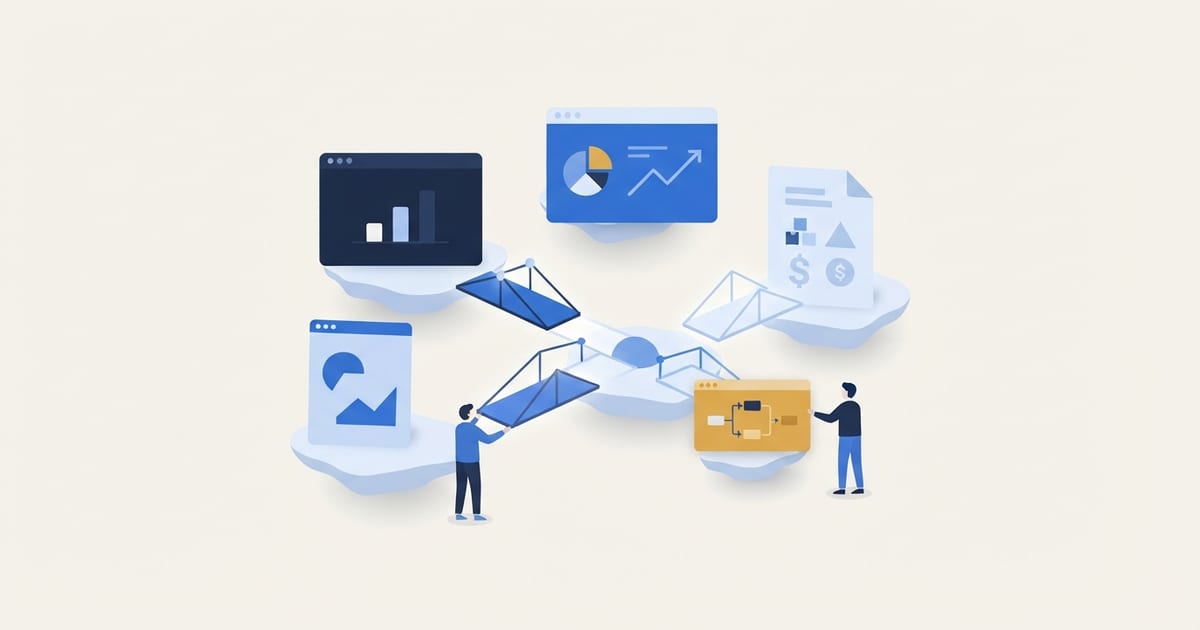
Walk into any small business today and you will find the same picture. There is QuickBooks for the books, Shopify or a website for sales, Trello or Asana for tasks, Mailchimp for the newsletter, Calendly for meetings, a CRM that someone set up two years ago, a couple of AI tools the owner is testing, and a handful of marketing platforms nobody fully uses.
And yet, somehow, the work still gets done with copy and paste, manual data entry, the same information typed into three different places, and spreadsheets holding the whole thing together.
Here is the part nobody wants to say out loud. Most businesses do not need more software. They need the software they already pay for to actually talk to each other.
The Hidden Cost of Disconnected Systems
When your tools do not communicate, your team becomes the integration. A lead comes in through a website form. Someone copies it into the CRM. Someone else adds it to a Trello board. A third person sends the follow-up email. By the time the customer hears back, two days have passed and the quote has gone cold.
Multiply that across every order, every quote request, every invoice, and every new client. The cost is not a single missed sale. It is the slow drag of duplicate entry, typos that turn into billing problems, follow-ups that never happen, and employees who spend half their week moving information between tabs instead of doing the work you actually hired them for.
None of this shows up as a line item on a P&L. It shows up as a business that feels busy but not productive. If that sounds familiar, this is usually why small businesses feel disorganized even when they are working hard.
What Automation Actually Looks Like
Automation is not robots. It is not a chatbot pretending to be a person. It is your existing tools handing information to each other so a human does not have to.
In practice it looks like this:
- A form on your website drops a new lead straight into your CRM.
- The CRM creates a task on the right Trello or project board.
- The team gets a notification in Slack or email without anyone forwarding anything.
- A Shopify order flows into your accounting system with the right category and tax treatment.
- A quote request kicks off a follow-up sequence so nothing goes cold.
- An AI chatbot captures a question after hours and lands it in your lead pipeline by morning.
None of this is exotic. It is the difference between systems that run and systems that need to be carried.
Example One: The Service Business
Picture a contractor, an agency, or a consulting firm. Quote requests come in through the website. Without any system in place, someone checks email, replies when they can, jots the lead on a sticky note, and hopes to remember the follow-up next Tuesday. Half the leads get a quick response. The other half never hear back.
Now connect the pieces. The form posts directly into the CRM. The CRM creates a task with a due date. The team gets pinged. If the lead does not respond in three days, a polite follow-up goes out automatically. The owner can open the CRM on Friday and see exactly where every opportunity stands.
Same business, same staff, same software budget. The only thing that changed is that the tools are wired together.
Example Two: The Ecommerce Business
A Shopify store sells physical products. Orders come in around the clock. Without integrations, someone has to watch the inbox, mark fulfillment in a spreadsheet, update inventory by hand, send tracking emails, and at the end of the month dump it all into QuickBooks.
With the right setup, the order triggers a fulfillment notification, updates inventory across channels, sends the customer a branded confirmation, posts the transaction to the accounting system with the correct revenue category, and rolls into a weekly sales report the owner actually reads.
The store does not need a bigger team. It needs fewer hands on each order.
Example Three: The Growing SMB
Now take a business with fifteen employees, two locations, three service lines, and a mix of recurring clients and new prospects. The owner cannot personally know what is happening on every job. Project status lives in someone's head. Reports are recreated from scratch every month. Accountability is fuzzy because nobody knows what was promised, by whom, and when.
Connected systems give you visibility. Every job has an owner, a status, a deadline, and a clear next step. Reports build themselves because the data is already structured. When something slips, you see it before the client does.
As complexity grows, the cost of disconnected systems grows faster than the business. This is the stage where building real systems stops being optional.
Why Most Businesses Never Build These Systems
It is not a lack of intelligence. It is a lack of time and a lack of roadmap. Owners are running the business. There are a hundred tools that all claim to solve everything. Software gets purchased before the workflow is ever mapped, which means the new tool joins the pile instead of replacing anything.
Technology does not create efficiency on its own. A workflow does. The software is just where the workflow lives.
Automation Is Really About Eliminating Repetitive Decisions
Every small decision your team makes during the day has a cost. Where does this lead go? Who is following up? What is the status of that job? Did we send the invoice? Did the client get the confirmation?
Notifications, task creation, lead routing, status updates, basic reporting. None of these need a human brain. Every repetitive decision you remove is time back for the work that actually moves the business forward.
Why Pinstripe Focuses on Systems Before Software
We do not start by recommending a tool. We start by looking at how the work actually moves through the business. Where does information enter? Where does it get stuck? Who is doing manual work that a system should be doing?
From there we map the workflow, identify the bottlenecks, and connect the systems you already have with intent. If a new tool is needed, fine. Often it is not. Often the stack is already capable, it just was never wired up.
That is the heart of our automation work and it is inseparable from how we approach consulting. If you want to see how this plays out in practice, take a look at how we work.
The Goal Is Not Automation. The Goal Is Better Operations.
Faster response times. Better visibility into what is happening. Fewer mistakes that cost real money. A customer experience that feels professional from first contact to invoice. An owner who is not pulled into every small decision.
Automation is a means, not the point. The point is a business that runs cleanly.
Before You Buy Another Subscription
Most businesses already have enough software. The hidden cost is in the gaps between the tools, not in the tools themselves. Connecting what you already pay for is often the highest ROI project available to a small business, and it does not require ripping anything out.
Before the next subscription, take an honest look at how your current systems talk to each other. If the answer is that they do not, that is the project worth doing first. When you are ready to map it out, our services are built for exactly this kind of work.
Free download, no email required
Automation Audit Scorecard
Score your recurring tasks by cost, readiness, and effort to see what to automate first and what to standardize before automating.
How to use it