Ask most small business owners where they spend their advertising budget and you will hear the same short list: Google, Facebook, Instagram, maybe TikTok. That has been the playbook for over a decade. It works, until it stops working, and then everyone scrambles to find the next channel.
Something is quietly shifting in the background. OpenAI has publicly confirmed it is testing advertising experiences inside ChatGPT for certain users in the United States, starting with Free and Go tier users. It is early. It is limited. And almost nobody in the small business world is talking about it yet. That last part is the part worth paying attention to.
What advertising inside ChatGPT actually means
Forget the social media model for a second. Inside ChatGPT, people are not scrolling. They are asking. They are typing real questions about real problems and waiting for an answer. That is a fundamentally different posture than someone half-watching a Reel between meetings.
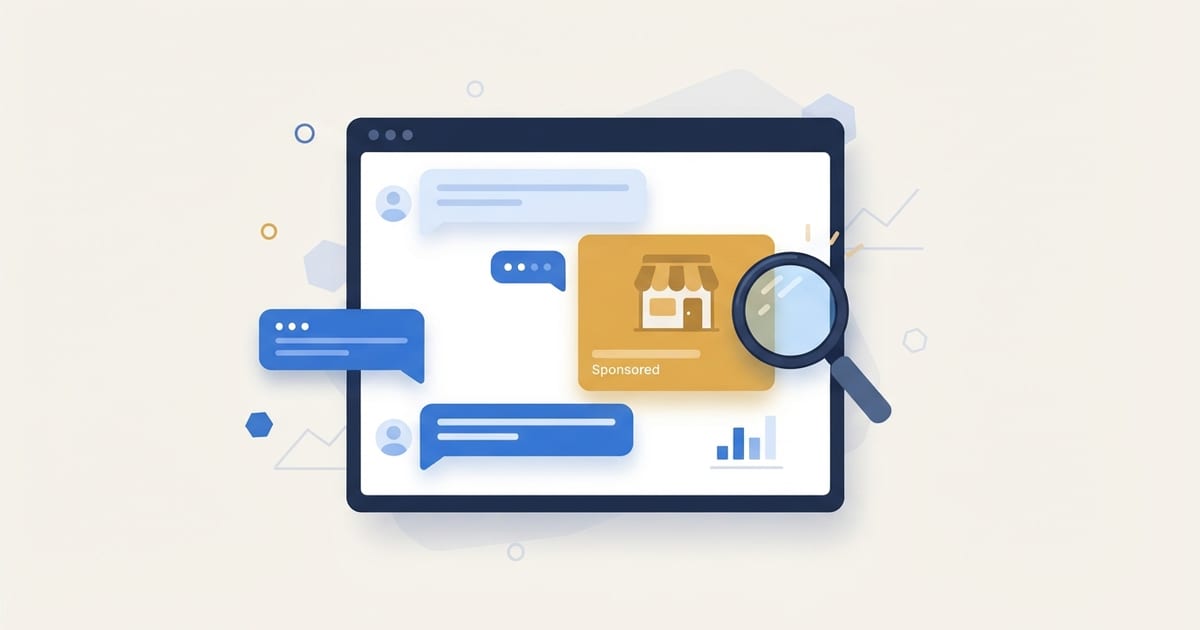
Sponsored placements inside that environment are designed to sit alongside relevant conversations. Someone asking about bookkeeping software, asking how to set up an LLC, asking which CRM works for a small service business. The ad shows up in the context of an actual decision being made in real time.
OpenAI has been clear that ads will be visually separated from organic responses and labeled as sponsored. That matters because the trust users have in the assistant only works if they can tell what is a recommendation and what is a paid placement. We will see how that plays out in practice, but the framing is intentional.
Why this could be a real opportunity for early adopters
New ad channels almost always follow the same curve. Costs are low at the start because nobody knows about them. A small group of businesses figures out how to use them well. Then everyone notices, costs go up, and the early movers have already built their pipelines.
That happened with Google Ads in the early 2000s. It happened with Facebook around 2012. It happened with TikTok in 2020. Whether ChatGPT advertising follows the same trajectory is not guaranteed, but the conditions look familiar. Lower competition, intent rich behavior, and a platform with massive daily active usage that most marketers have not figured out yet.
If you run a small business and you are watching this space early, you are not buying clicks. You are buying time to learn before the cost of learning goes up.
This is not just another social platform
Social media advertising is interruptive by design. You catch someone mid scroll and try to pull their attention. It works, but it is fighting the user, not helping them.
Conversational advertising inside an AI tool is closer to search than to social. People come in already trying to solve something. They are researching, comparing, troubleshooting, asking for recommendations. The ad does not have to manufacture interest. The interest is already on the screen.
That is a different kind of marketing problem. It rewards businesses that can match a clear offer to a clear question, with a landing page that actually answers what was asked. That part is not new. The platform is.
Why most small businesses will miss the early window
Most owners are still trying to figure out the latest Instagram algorithm change. They are knee deep in TikTok strategy meetings or wondering if they should be on Threads. By the time the average business owner hears that ChatGPT advertising is a thing, the early window will already be closing.
This is not a knock on small businesses. It is just how new channels move. The owners who pay attention early are not always the smartest ones in the room. They are usually just the ones who keep an eye on what is shifting and ask the question before everyone else does.
New tech does not replace the fundamentals
Here is the part that gets lost in every wave of new advertising hype: the channel is the easy part. The hard part is what happens after the click.
If your website is slow or unclear, ads will not save you. If your offer is vague, ads will not save you. If your follow up is disorganized and leads sit in an inbox for three days, ads will absolutely not save you. Plenty of businesses spent thousands chasing the next platform before they had any of the basics in place. The platform changed. The result did not.
Before any business considers a new advertising channel, the foundation matters more than the campaign. Clear positioning. A landing page that converts. An automation layer that catches leads and keeps them moving. A strategy that ties it all together. None of that is exciting. All of it is the difference between paying for traffic and actually growing.
The real edge is intent
The reason this channel is interesting has less to do with ChatGPT itself and more to do with the behavior happening inside it. Someone asking an AI a specific business question is much further down the decision path than someone scrolling a feed. The targeting opportunity is not demographic. It is contextual.
If a business sells accounting services, the difference between reaching someone who fits the demographic profile and reaching someone who literally just typed "how do I clean up my books before tax season" is enormous. That is the kind of intent signal that has historically only existed inside Google search. Now it may exist inside conversational AI too.
Whether the targeting tools mature fast enough to take advantage of that, and whether the ad units stay clearly labeled and trustworthy, is something we are all watching in real time. But the underlying behavior is real, and it is growing.
We are watching this space closely
At Pinstripe we spend a lot of time at the intersection of marketing systems and operational follow through. New channels do not impress us on their own. What matters is whether a business is ready to actually do something with the leads when they show up.
AI advertising is going to be one of the bigger shifts in the next few years. We do not think that is hype. We also do not think it is going to fix anyone's business overnight. It is a channel. Channels reward operators who are prepared. We help businesses get prepared. That is most of what we do across our services, and it is the philosophy behind how we work.
If a business wants to be in a position to test new ad channels as they open up, the work starts well before the first ad runs.
Why businesses should start preparing now
Preparation for this kind of shift is not glamorous and it is not optional. The businesses that move fastest when ChatGPT advertising opens up more broadly will be the ones who already have:
- A website that loads fast and reads clearly
- Landing pages built to match specific offers, not a generic homepage
- Service positioning that a stranger can understand in under thirty seconds
- A CRM or simple system that captures every lead in one place
- Automation workflows that respond quickly and route leads to the right person
- Tracking in place so they actually know what is working
None of that requires AI advertising to exist. All of it makes a business better today. If you want a starting point, our piece on how to build systems for a small business walks through the operational layer that has to be in place before any new channel makes sense.
The takeaway
Advertising inside ChatGPT is real. It is also early. The space is going to evolve fast and it is going to look different in six months than it does today. Most small businesses will ignore it until competition makes it expensive, and then they will wish they had paid attention sooner.
You do not need to spend money on a new channel today to be ready for it. You need to know it is coming, and you need to make sure the rest of your business is built to take advantage when the moment is right. The businesses that get that part right are the ones who tend to win the next decade, not the last one.
Free download, no email required
Automation Audit Scorecard
Score your recurring tasks by cost, readiness, and effort to see what to automate first and what to standardize before automating.
How to use it