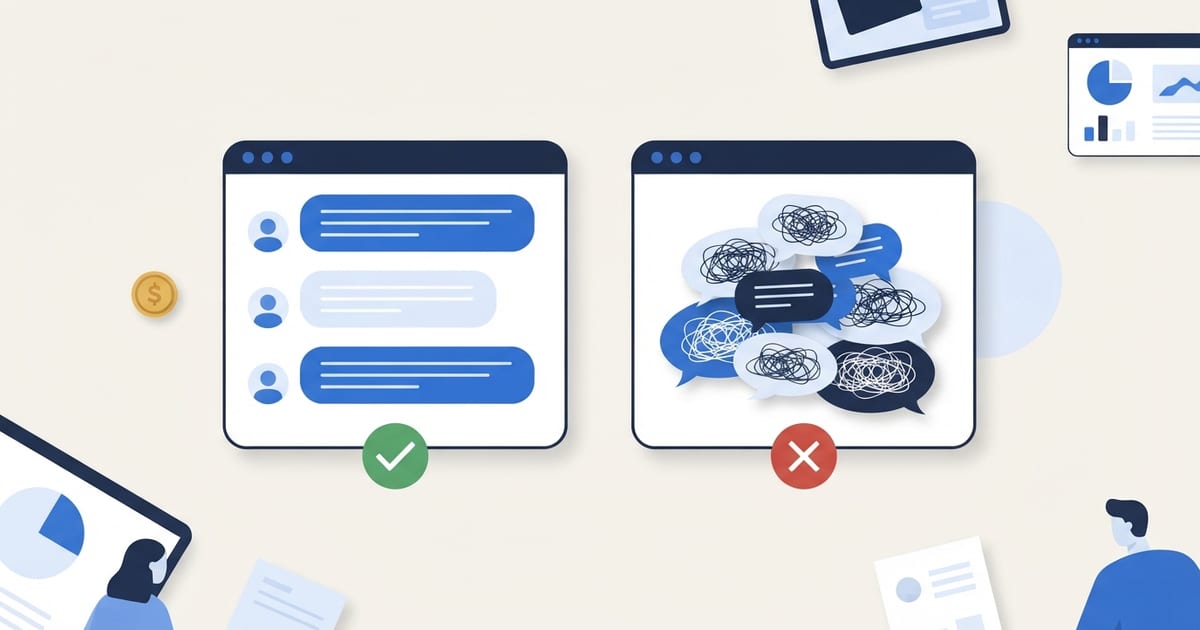
Having a Chatbot Does Not Mean It Is Working
There is a growing assumption that putting a chatbot on your website automatically improves things. More engagement. More leads. Better customer experience. Just install the widget and watch the magic happen.
That is not how it works. Most chatbots on small business websites are doing nothing useful. They pop up with a generic greeting, fail to answer anything specific, and frustrate visitors more than they help them. The business owner assumes the chatbot is handling things when in reality it is just taking up space.
The difference between a chatbot that drives results and one that drives people away comes down to how it is built, what it knows, and whether it connects to anything meaningful behind the scenes.
What a Bad Chatbot Looks Like
You have probably encountered these. You visit a website, a chat bubble pops up, and you try asking a question. The response is something like "I am sorry, I did not understand that. Can you try rephrasing?" Or it gives you a generic answer that has nothing to do with what you asked.
Bad chatbots share a few common traits:
- Generic responses. They can say "hello" and point you to the contact page, but they cannot answer a real question about the business, its services, or its pricing.
- No conversational guidance. The chatbot waits for the visitor to drive the conversation. There is no direction, no prompting, no clear path forward.
- Robotic tone. Every response feels canned. There is no sense that the chatbot understands what the visitor actually needs.
- No information captured. The conversation happens and then disappears. No name, no email, no details about what the visitor was looking for. The business gets nothing from the interaction.
A bad chatbot does not just fail to help. It actively hurts the experience. A visitor who tries to engage with a chatbot and gets useless responses walks away with a worse impression of the business than if the chatbot was not there at all.
Why Most Chatbots Fail
The problem is usually not the technology. It is the implementation.
Most chatbots are installed out of the box with zero customization. The business owner signs up for a chatbot service, drops the widget on the site, and never configures it with actual business information. The chatbot does not know what the business does, what services it offers, how pricing works, or what the customer should do next. It is flying blind.
There is no structure behind the conversations. No defined paths for common questions. No logic for qualifying a lead or guiding someone toward a next step. The chatbot just reacts to whatever the visitor types, usually poorly.
And there is no connection to anything downstream. Even when the chatbot does capture a piece of information, it does not go anywhere. No notification to the owner. No entry in a CRM. No follow-up triggered. The chatbot operates in a vacuum, disconnected from the actual business.
Then it gets forgotten. Nobody reviews the conversations. Nobody updates the responses. Nobody checks whether it is actually producing results. It just sits there, month after month, doing nothing.
What a Good Chatbot Actually Does
A good chatbot feels like talking to someone who knows the business. Not a human, but a knowledgeable assistant that can actually help.
- Responds instantly and clearly. The visitor asks a question and gets a relevant answer within seconds. Not a redirect to the FAQ page. An actual answer.
- Answers real customer questions. What services do you offer? How much does this cost? What is your process? How quickly can you start? A good chatbot handles these because it has been trained on the business. Understanding what a chatbot should be doing starts with this basic capability.
- Guides the conversation forward. Instead of waiting for the visitor to figure out what to ask, the chatbot prompts them. "Are you looking for bookkeeping support or automation help?" "Would you like to schedule a call to discuss this further?" It moves the conversation toward a conversion.
- Captures lead details naturally. Through the conversation, the chatbot collects the visitor's name, email, and what they need. Not through a static form, but as a natural part of the dialogue.
- Creates a clear next step. Every conversation should end with something actionable. A booked call, a submitted inquiry, a quote request. The chatbot does not just chat. It converts.
It Is Not Just AI. It Is the System Behind It.
The chatbot itself is only one piece. What makes it effective is everything that happens after the conversation.
A good chatbot feeds captured leads into a workflow. The owner gets notified. The lead gets a confirmation email. A follow-up is scheduled. The information is organized and accessible, not buried in a chat log that nobody reads.
Automation is what connects the chatbot to the rest of the business. Without that connection, you have a smart conversation tool that produces dead-end interactions. With it, you have a lead capture system that runs 24 hours a day and feeds directly into your sales process.
This is also why businesses miss website leads even when they technically have a chatbot. The front end works, but there is nothing behind it. The lead gets captured and then sits there.
Real Business Impact
When a chatbot is properly built and connected, the results are measurable.
More leads get captured because visitors who would have left without doing anything now have a reason to engage. The chatbot catches the people who would not have filled out a contact form but will answer a few questions in a conversation.
Response times drop to seconds. That speed alone increases conversion rates significantly. A visitor who gets an immediate response is far more likely to continue the conversation than one who submits a form and waits.
The customer experience improves because every visitor gets the same quality of interaction. No bad days. No slow responses. No missed messages. Consistency builds trust, and trust drives conversions.
And all of this happens without adding workload. The chatbot handles the initial engagement. The owner steps in for the conversations that actually require a human. It is leverage, not labor.
How to Tell If Your Chatbot Is Actually Working
If you already have a chatbot on your site, ask yourself these questions:
- Are conversations actually turning into leads? If the chatbot is having conversations but none of them result in captured contact information, it is not doing its job.
- Are those leads being followed up? If the chatbot captures a lead but nobody responds for two days, the chatbot is working but the process behind it is not.
- Are real questions being answered? Test it yourself. Ask the questions your customers ask. If the chatbot cannot handle them, neither can your visitors.
- Is it saving you time or creating confusion? If you are spending time cleaning up after bad chatbot interactions, the tool is a liability, not an asset.
A chatbot that does not produce measurable results is not a chatbot. It is a decoration.
What to Look for When Choosing a Chatbot Solution
If you are evaluating chatbot options for your business, focus on what matters:
- Customization. The chatbot needs to be trained on your business. Your services, your pricing, your process, your tone. Generic does not work. Look for an AI chatbot built specifically for small business that allows real customization without requiring a developer.
- Integration. It needs to connect to your email, your CRM, or whatever system you use to manage leads. If the chatbot cannot feed into your workflow, it is a standalone toy.
- Focus on conversion. The best chatbots are designed around lead capture and next-step guidance. Not just answering questions, but moving the visitor toward an action.
- Simplicity. If setup takes weeks and requires a technical team, it is overbuilt for a small business. The right solution should be simple to configure and easy to maintain.
Understanding the landscape of live chat and AI chat options can help you make a more informed choice about what fits your business.
Not All Chatbots Are Equal
A bad chatbot is worse than no chatbot. It frustrates visitors, misses leads, and gives the owner a false sense that their website is "covered." A good chatbot is a genuine business tool that captures opportunities, improves the customer experience, and supports the sales process around the clock.
If your current chatbot is not producing results, the problem is probably not the concept. It is the execution. And if you do not have one yet, the right setup can start capturing leads you are currently losing every single day.
If you want to figure out where AI chat fits into your business, looking at the full picture of support options is a good place to start. The technology works. It just needs to be built right.
Free download, no email required
Automation Audit Scorecard
Score your recurring tasks by cost, readiness, and effort to see what to automate first and what to standardize before automating.
How to use it