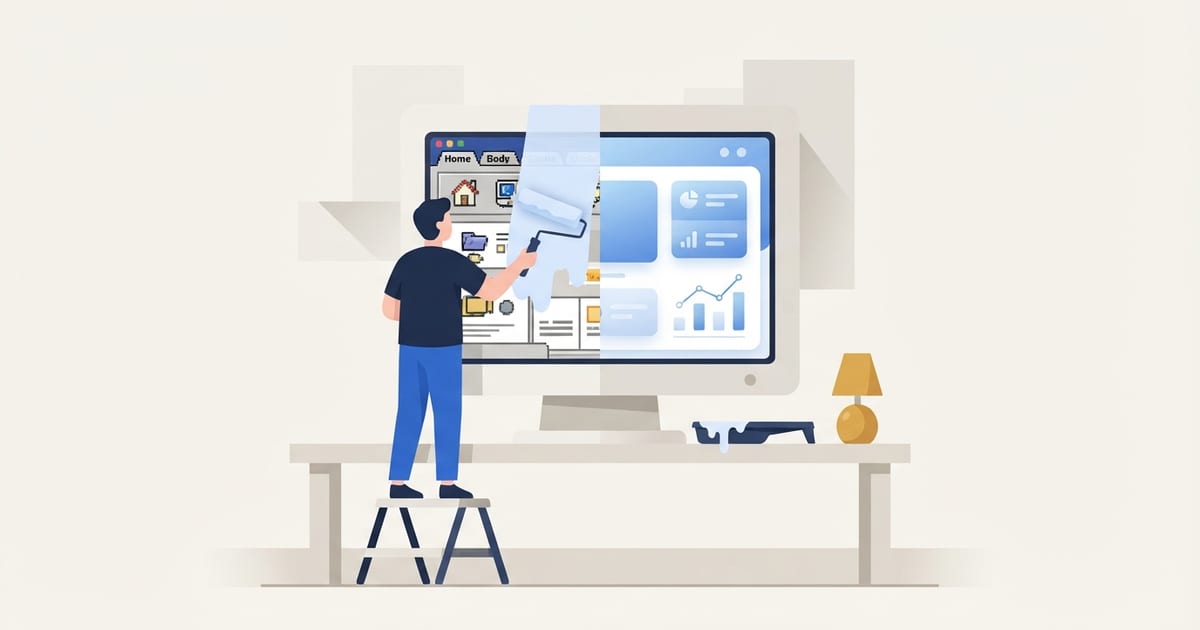
Your Website Might Be Holding You Back (Without You Realizing It)
Your website is live. It has your services listed. There's a contact page somewhere. And you haven't thought about it in a while, because it's "done."
But here's the thing: a website that was fine two years ago might be quietly costing you business today. Design standards change. User expectations evolve. What felt modern in 2023 can feel dated now, and dated websites don't convert.
If you're not sure whether your site needs work, it probably does.
Signs Your Website Needs a Refresh
You don't need a full audit to spot the warning signs. If any of these sound familiar, your website is due for attention:
- Outdated design: the layout, fonts, or colors feel like they belong to a different era
- Slow load times: pages take more than three seconds to load, especially on mobile
- Confusing navigation: visitors can't find what they need in two clicks or less
- No clear CTA: there's no obvious next step on your most important pages
- Poor mobile experience: the site looks or functions poorly on a phone
Any one of these is a problem. Multiple? That's a site that's actively working against you.
Why This Actually Impacts Your Business
Lost leads. A visitor who can't quickly understand what you do or how to contact you will leave. They won't try harder. They'll go to the next result in their search. Every confusing page, every missing CTA, every slow-loading section is a potential client walking away.
Poor user experience. People form opinions about your business based on your website, in seconds. A cluttered, outdated, or hard-to-navigate site tells visitors that your business isn't professional, even if your actual work is excellent.
Lower trust. Your website is often the first interaction someone has with your business. If it doesn't look credible, they won't trust you with their money. Design quality signals business quality. Fair or not, that's how visitors think.
What a Modern Small Business Website Should Do
A website that works for your business does three things well:
Guide users. Every page should have a logical flow: from headline to explanation to action. Visitors should never wonder "what do I do next?" The structure should answer that question before they ask it.
Convert visitors. Your site should turn traffic into leads. That means clear calls to action on every important page, easy-to-use contact forms, and a path from interest to inquiry that takes as few steps as possible. For more on how this works in practice, see our guide on building a website that generates leads.
Clearly explain services. Visitors should understand what you offer, who you help, and why it matters, without digging. If someone has to click through three pages to understand your core service, your messaging needs work.
Common Mistake: Treating Your Website Like a One-Time Project
Most small businesses build a website once and forget about it. They treat it like a brochure: print it, distribute it, move on.
But a website isn't a brochure. It's a living tool that needs to evolve with your business. Services change. Messaging improves. Design trends shift. What worked when you launched may not work now.
The businesses with the best-performing websites treat them as ongoing assets, reviewing, updating, and improving them regularly.
Quick Wins You Can Fix Right Now
You don't always need a full redesign. Sometimes small changes make a measurable difference:
- Clearer CTAs: replace generic "Contact Us" buttons with specific actions like "Schedule a Free Consultation" or "Get a Quote"
- Better headlines: lead with the problem you solve, not your company name or a vague tagline
- Simpler layout: remove clutter, reduce menu items, and give each page a single clear purpose
These changes take hours, not weeks, and they can immediately improve how visitors interact with your site. Our guide on SEO-friendly website design covers more structural improvements that impact both visibility and conversions.
When It's Time for a Full Refresh
Quick fixes only go so far. Sometimes the foundation needs to change.
Outdated structure. If your site was built on an old platform, uses rigid templates, or can't be easily updated, patching it won't solve the underlying limitations. A modern site needs a modern foundation.
Design limitations. When the layout can't accommodate your current services, when the visual style doesn't match your brand anymore, or when every change requires workarounds, it's time to rebuild, not repair.
Performance issues. Slow load times, broken mobile layouts, and poor Core Web Vitals scores signal technical debt that surface-level changes can't fix. If the performance problems are structural, the solution needs to be structural too.
How Pinstripe Builds Websites That Actually Work
At Pinstripe, we build websites that are simple, clean, and built to convert. Not because minimal is trendy. Because minimal works.
Every site we build starts with clarity:
- Clear messaging that speaks to your audience's problems
- Clean layouts that guide visitors instead of overwhelming them
- Strong calls to action tied to real business outcomes
- Fast performance on every device
We also understand that a website connects to how your business operates. That's why our web design work is informed by our consulting and automation experience: we build sites that don't just look good, but function as part of your larger business system.
Learn more about how we work with clients, or explore the Learning Center for more on building a digital presence that performs.
Final Thought
Your website should be working for your business, not just existing. It should be generating leads, building trust, and making it easy for the right people to take the next step.
If it's not doing that, the question isn't whether you need a refresh. It's how much business you're losing by waiting.