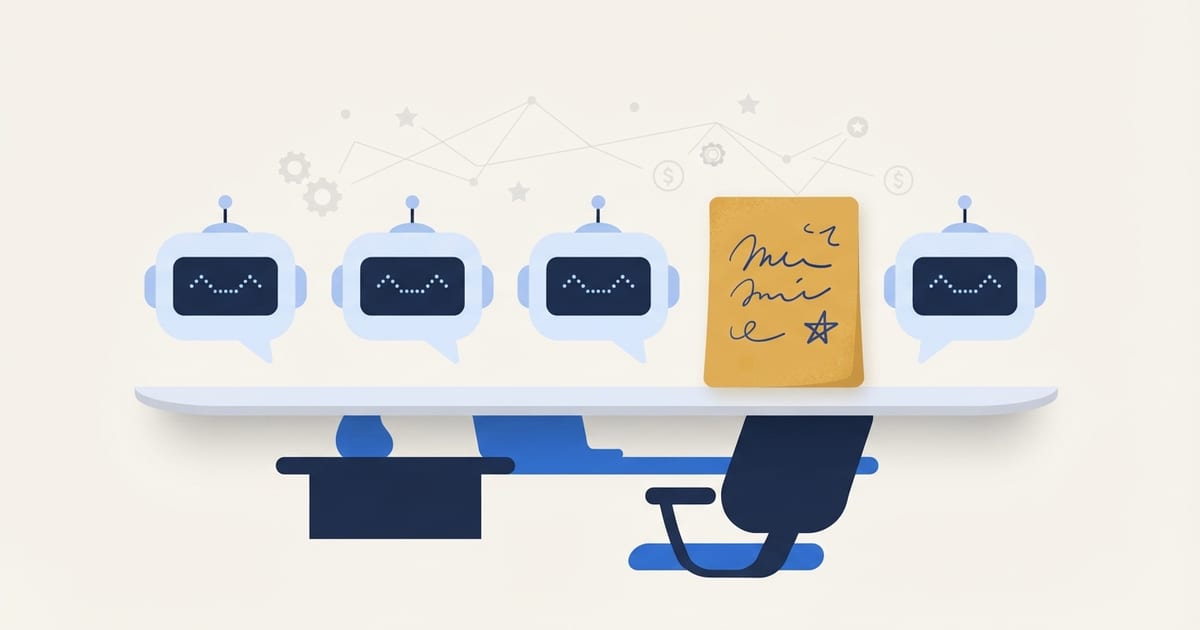
AI tools have made it incredibly easy to respond to customers. Draft an email in seconds. Generate a reply to a review. Auto-respond to an inquiry. The speed is real, and the appeal is obvious. When you are running a business and buried in messages, anything that saves time feels like a win.
But there is a line between using AI to move faster and letting AI speak for you entirely. And a lot of businesses have crossed it without realizing what it is costing them.
Why Business Owners Lean on AI Too Much
It starts with convenience. You get a customer email, paste it into ChatGPT, get a polished response, and hit send. It takes thirty seconds instead of ten minutes. You do that once, and it feels like a cheat code. So you do it again. And again. And eventually, every customer interaction runs through the same process.
It removes effort. It removes the mental load of crafting a reply. It makes every response sound professional, even when you are exhausted or distracted. For a business owner who is already stretched thin, it feels like the smartest move available.
But efficiency is not the same thing as effectiveness. And what feels fast on your end can feel hollow on theirs.
What Customers Are Starting to Notice
Here is the thing most business owners have not caught up to yet: your customers are using AI too. They know what it sounds like. They know the cadence. They recognize the overly polished, slightly generic tone that every AI tool defaults to.
When someone sends you a message and gets back a response that reads like it was written by a language model, they notice. Maybe they do not say anything. But the feeling registers. The reply is too smooth. Too clean. Too devoid of personality. It does not sound like a person wrote it. It sounds like a machine did.
And when that happens, the interaction stops feeling like a conversation and starts feeling like a transaction. The customer does not feel heard. They feel processed.
Why This Hurts More Than It Helps
Trust is built through communication. Not through perfect grammar or polished phrasing. Through tone, personality, and the sense that someone on the other end actually read what you wrote and responded to it specifically.
When every reply sounds the same, when every email has the same structure and the same neutral-positive tone, the business starts to feel less real. It feels like a template. And people do not build loyalty with templates.
This is especially true for service-based businesses. If someone is considering hiring you for consulting, bookkeeping, web design, or automation, they are evaluating whether they want to work with you. Not with your AI. If the first few interactions feel automated, you have already lost ground before the real conversation starts.
The irony is that AI is supposed to help you communicate better. But when it replaces your voice entirely, it does the opposite. It removes the thing that made your communication worth reading in the first place.
The Difference Between Using AI and Relying on It
There is a big difference between using AI as a tool and using it as a replacement. A tool helps you do something better. A replacement does it for you. When AI becomes the replacement for your voice, your tone, and your judgment, it stops being helpful and starts being a liability.
Using AI to brainstorm ideas for a response is smart. Using AI to write the entire response, send it without editing, and move on is lazy. And customers can feel the difference even if they cannot articulate exactly what is off.
The businesses that use AI well treat it like a first draft. They let it do the heavy lifting on structure and then they add the human layer: the tone, the context, the personality. The ones that use it poorly treat it like a finished product.
Where AI Actually Helps
AI is genuinely useful in the right contexts. It is great at summarizing long conversations so you can quickly get up to speed. It can highlight key points from a thread that has gone back and forth too many times. It can draft rough ideas when you are stuck on how to start a message.
It is also valuable for organizing responses. If you need to reply to a complex email with multiple questions, AI can help you structure your answer so nothing gets missed. That is a real time-saver that does not sacrifice quality.
The key is using AI for the parts of communication that do not require a human touch. The prep work. The organization. The framework. Not the final product. If you want to see how automation can support your business operations without replacing the human element, that balance is exactly what matters.
Where You Should Still Be Involved
Anything that touches the customer relationship directly should have your fingerprints on it. The final tone of a message. The way you address a complaint. The follow-up after a project wraps. These are the moments that build trust, and they need to sound like you.
Personalization is not about using someone's first name in an email. It is about responding in a way that shows you actually understood what they said. AI cannot do that well because it does not know the relationship, the history, or the nuance. You do.
This is especially important when responding to customer inquiries quickly. Speed matters, but not at the expense of authenticity. A fast reply that feels generic is worse than a slightly slower reply that feels real.
Why This Matters More Now Than Before
A year ago, AI-generated text was harder to spot. The novelty was still there. People were not as trained to recognize it. That window is closing fast.
Now, most people have used ChatGPT or something similar. They know the patterns. They know the phrasing. When they receive a message that sounds like it came from a language model, the reaction is not "wow, that was well-written." It is "that was not written by a person."
Overuse of AI in communication is becoming a negative signal. It tells the customer that you did not care enough to write the message yourself. Whether that is fair or not does not matter. Perception is reality in business, and the perception is shifting.
The Right Balance
The goal is not to stop using AI. The goal is to stop letting it replace you.
Use AI to move faster. Use it to organize your thoughts, structure your replies, and handle the repetitive parts of communication that do not require personality. But keep the human element in everything that faces the customer.
Focus on clarity and authenticity. If a customer reads your reply and feels like a real person wrote it, you are doing it right. If they read it and feel like they are talking to a bot, you have a problem.
The businesses that will win over the next few years are the ones that use AI properly: as a tool that amplifies their voice, not one that replaces it. AI chatbots have a real place in small business, and so does live chat. But knowing when to automate and when to show up personally is the difference between a business that builds relationships and one that processes transactions.
If you are not sure where that line is for your business, that is worth figuring out before your customers figure it out for you.
Free download, no email required
Automation Audit Scorecard
Score your recurring tasks by cost, readiness, and effort to see what to automate first and what to standardize before automating.
How to use it